
Evidence of traditional irrigation can be found in considerable numbers in the Tyrolean Oberland (North Tyrol). Supply lines - called Waale here - can be found from above Landeck (Prutz and Grins) down to Imst and Tarrenz (usually run by a local Waalgenossenschaft). The Tyrolean Oberland is crossed by the Inn and its tributaries and is a classic inner-Alpine dry valley. The deeply sunken valley floors and the lee-side mountain slopes in particular are pronounced dry islands. While most of the rain falls in summer due to heat storms, there is a lack of precipitation for plant growth in April and May. Accordingly, the main aim of irrigation in the Tyrolean Oberland is to moisten rather than fertilise.
Traditional irrigation is probably an ancient phenomenon in Landeck, as traces of Bronze Age settlements have been found on the Stanzer Terrasse. The actual irrigation culture then developed with the large-scale colonisation by the Rhaeto-Romans. The largest contiguous and actively cultivated traditional irrigation area (25 hectares) lies on the valley floor of Perjen, irrigated by around 30 members of the Landeck-Perjen Corporation. The old Stanzer Waal, which runs through the mountain forest between Grins and Stanz, has been restored. As in the past, the edges of the banks were reinforced with boulders and the Stanz primary school even installed a ‘Waaler bell’ again.
Read more and discover:
Book volume (in German): Traditionelle Bewässerung – ein Kulturerbe Europas, Band 2, Regional Documentation
Austrian National Commission UNESCO, www.unesco.at
Various water co-operatives exist in the Tyrolean Oberland.
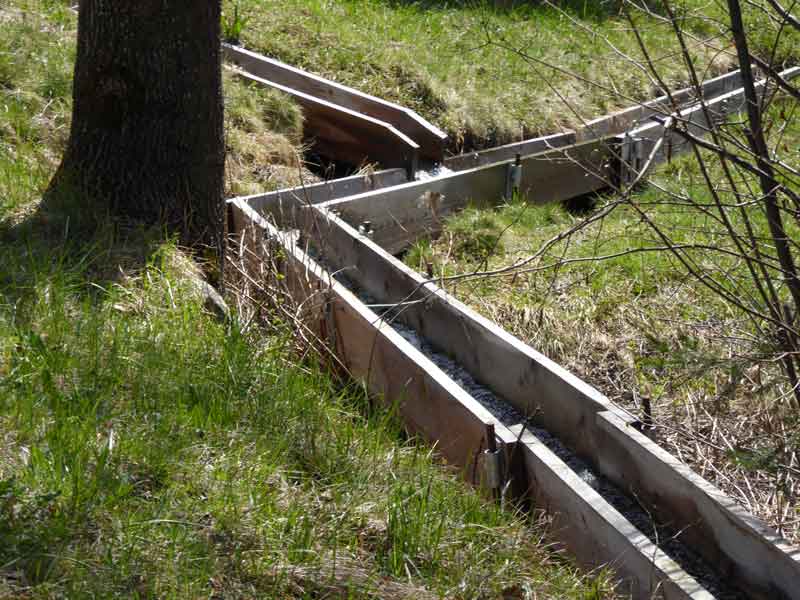
Waale and water meadows: Stanz © Burghard Fiechtner