
Lommel-Kolonie is located in the Limburg Kempen, right on the border with the Netherlands. Here, on the northern edge of the Heuvelsche Heide, the agricultural colony (colonie agricole) was founded by the Belgian state in 1849. One of the reasons for this was a food crisis caused by the potato blight that had been rampant since 1845. A prerequisite for the colonisation of the heath and the establishment of an irrigation system was the construction of a canal that could bring in sufficient water from the Meuse and at the same time enable a more efficient exchange of goods. The Kempenkanaal had already been built in 1844 and was now supplemented with the ‘Grote Spijsslot’ supply canal. To the left and right of this, 10 state farms were built, each with one hectare of Vloeiweiden (water meadows).
However, the overall concept did not work and Lommel Colony had to be sold to a private owner in 1860. Nevertheless, the Grote Watering is a prime example of irrigation using the artificial ridge system. Due to the flat landscape, it was necessary to work with very small differences in height. Even today, parts of the irrigated meadows (9 ha) are still irrigated using the traditional trickle system, making it the largest traditional irrigation system in the North Sea/Baltic Sea region. Lommel-Kolonie has been a nature reserve since 1997 and a listed landscape since 2002.
Read more and discover:
Book volume (in German): Traditionelle Bewässerung – ein Kulturerbe Europas, Band 2, Regional Documentation
Wateringhuis website, www.natuurpunt.be/bezoekerscentra/natuurhuis-wateringhuis
Natuurpunt: www.natuurpunt.be
Erfgoed Lommel (Cultural Heritage Lommel), erfgoedlommel.be
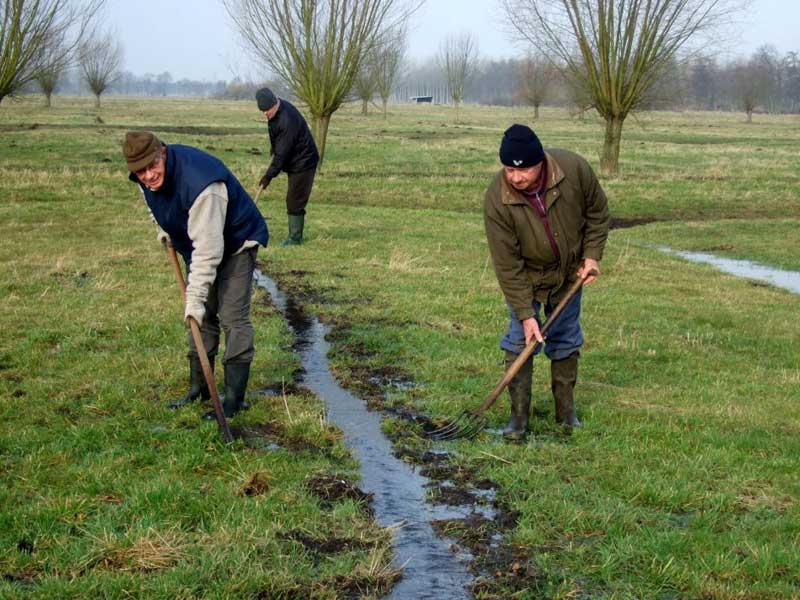
Watering in the large colony of Lommel, © Albert Mertens