
In the northern part of Luxembourg, the Ösling (Luxembourgish Éislek), irrigation is called ‘Fléizen’. While in the rest of the Ardennes, irrigation was normally carried out on the plateaus and slopes, traces of traditional irrigation in the Ösling can be found at all altitudes, from the small valleys on the plateaus down to the broad valley floors of all the larger bodies of water. On the one hand, irrigation was and still is carried out at the end of winter or beginning of spring in order to thaw snow and ground frost and to raise the soil temperature (earlier start of vegetation). On the other hand, summer irrigation improved the yield of the second cut of grass (often limited by drought), while in autumn the focus was on the fertilising effect. Today, the Öewersauer Nature Park operates an irrigation system in a small meadow valley near Esch-Sauer. Due to the steep gradient, short, small ditches branch off from the stream at a distance of around 10 metres on both sides, resulting in the herringbone pattern typical of this type of system. The Aarbechtsgrupp Fléizen is also working on historical-geographical research to document and visualise the former distribution and significance of the Fléizen. This ranges from field work to map, aerial photo and lidar analyses to archive work.
Read more and discover:
Book volume (in German): Traditionelle Bewässerung – ein Kulturerbe Europas, Band 2, Regional Documentation
Aarbechtsgrupp Fléizen, further information and contact about the Öewersauer Nature Park, www.naturpark-sure.lu/projects/fleizen/
Web Walking webwalking.lu/wwal-tax-topic/fleizen-wiesenbewasserung-zu-letzebuerg
National Inventory of Intangible Cultural Heritage www.iki.lu
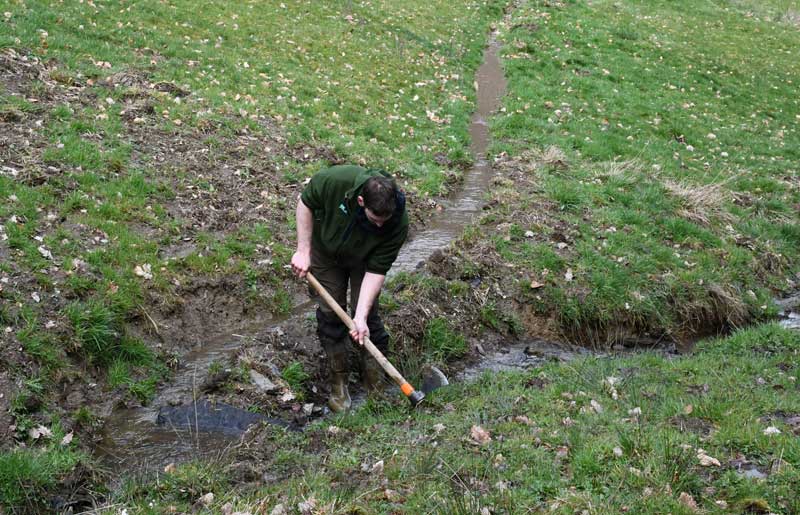
Fléizen - Meadow irrigation in Luxembourg: © IZTB